
Give us a call now at:
(844) 489-LOVE
 |
One of the questions we're asked most often is:
"How do you know if two people are truly compatible?"
It's a great question.
Because compatibility is one of those words everyone uses...but very few people ever define.
Many people assume compatibility simply means finding someone who:
Enjoys the same hobbies
Makes them laugh
Shares similar interests
Feels exciting to be around
Those things certainly help.
They're often what creates a great first date.
They're just not usually what determines whether a relationship still feels happy, supportive, and connected years later.
Professional matchmakers tend to look at compatibility a little differently.
Instead of asking,
"What do these two people have in common?"
We're usually asking,
"How well do these two lives actually fit together?"
There's an important difference.
Think of it like building a house.
People naturally notice things like:
The beautiful front door
The large windows
Fresh paint
Beautiful landscaping
Incredible curb appeal
Those things absolutely matter.
They're what catch your eye.
But if the foundation isn't solid...
None of those things can carry the weight of the house.
Relationships work much the same way.
Chemistry catches your attention.
Compatibility supports everything that comes after.
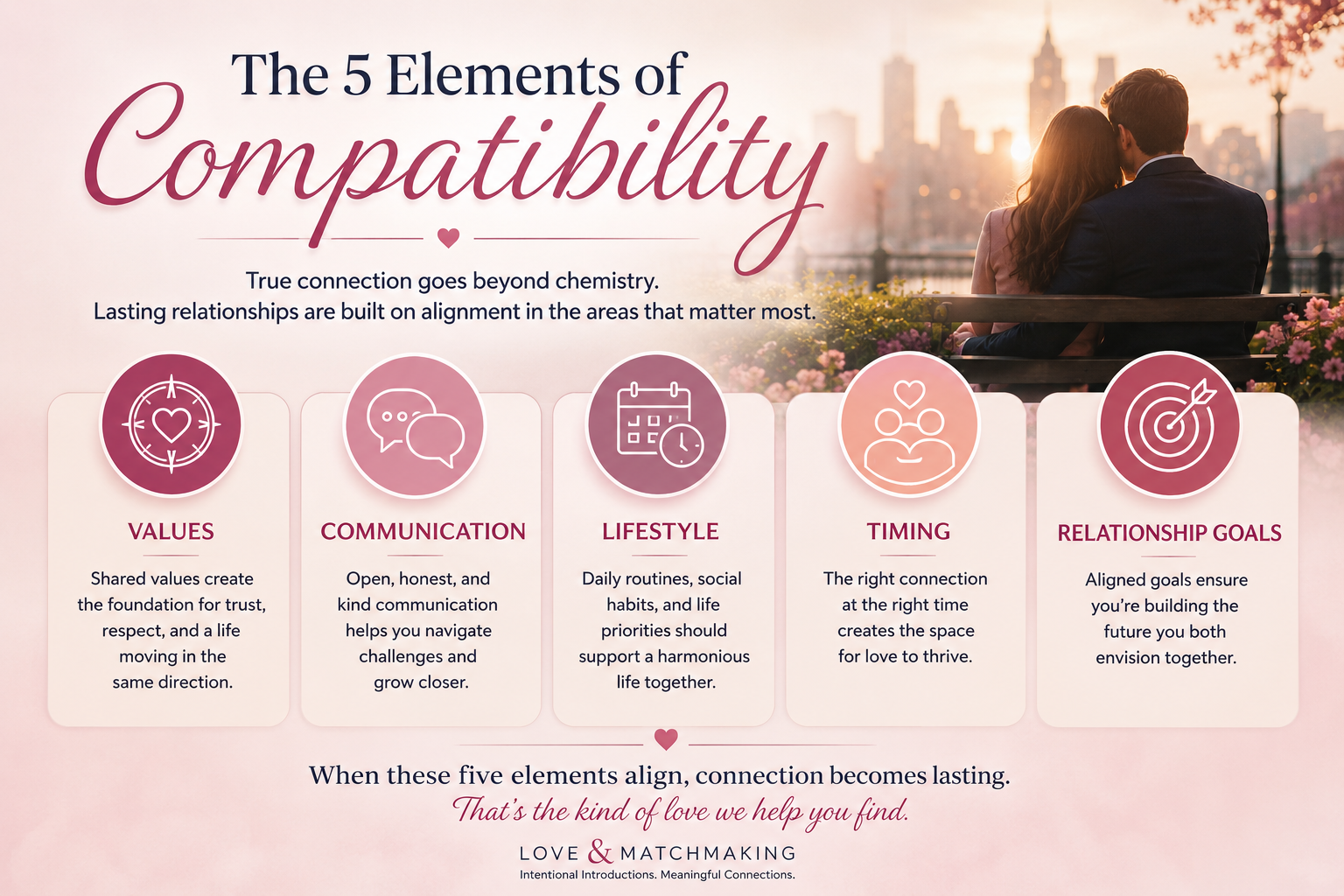
That's why we use what we simply call the Love & Matchmaking Compatibility Framework.
It isn't a personality test.
It isn't a scorecard.
And it certainly isn't designed to predict the future.
It's simply a practical way of looking at the five areas that most consistently influence whether attraction grows into a healthy, lasting relationship.
One of the biggest misconceptions about dating is that successful relationships happen because two people simply have enough in common.
In reality, lasting relationships are usually built on something much quieter.
The strongest couples often share:
Similar values
Communication that makes each other feel heard
Lifestyles that naturally fit together
The same stage of readiness for a relationship
A future that makes sense for both people
None of those things are especially glamorous.
They rarely make for exciting dating stories.
But they're often the reason one couple grows stronger over time...
...while another slowly grows apart.
Those are the patterns professional matchmakers pay attention to because they're the same patterns that continue to matter long after the excitement of a first date fades.
That's exactly why this framework exists.
Not to make dating more complicated.
To make compatibility easier to understand.
The framework looks at five areas that, together, tell a much more complete story than chemistry ever could.
The beliefs and principles that quietly influence everyday decisions.
Things like:
Trust
Honesty
Family
Kindness
Generosity
Personal responsibility
These are often the invisible threads holding a relationship together.
How two people:
Listen
Disagree
Solve problems
Repair misunderstandings
Make each other feel understood
Good communication isn't about never disagreeing.
It's about feeling respected while you do.
The practical side of sharing a life.
Including:
Daily routines
Career priorities
Finances
Family expectations
Social life
Pace of life
Love lives in everyday life.
That's why lifestyle matters more than people often realize.
Sometimes two wonderful people meet...
...at exactly the wrong moment.
One may still be healing.
One may be building a business.
One may simply not have room for a relationship.
Readiness often matters just as much as attraction.

Not identical dreams.
Simply a future that comfortably fits two people.
Because even great chemistry struggles when two people are walking toward very different destinations.
One thing we'd encourage you to remember as you read the rest of this guide...
Chemistry matters.
It really does.
It can be:
Exciting
Memorable
The reason you can't stop thinking about someone after a first date
The spark that makes you want to know someone better
But chemistry is only the beginning.
That's why professional matchmakers spend so much time learning about the parts of people that don't always appear on a dating profile.
Because while attraction often starts a relationship...
Compatibility is usually what carries it forward.
Relationship researchers have consistently found that couples with stronger communication, shared commitment, and mutual understanding report higher levels of relationship satisfaction over time.
"Relationship quality is consistently associated with effective communication, mutual understanding, and shared commitment." — National Institutes of Health
Decades of relationship research by Drs. John and Julie Gottman reached a remarkably similar conclusion.
Rather than focusing on dramatic moments, they found that healthy relationships are built through thousands of small, everyday interactions that strengthen trust, friendship, and emotional connection over time.
"Small things often become the big things in relationships." — The Gottman Institute
Source: https://www.gottman.com/
One of the nicest compliments we hear from clients isn't:
"You found me the perfect person."
It's usually something much simpler.
"Being with them just feels... easy."
That word comes up surprisingly often.
Easy.
Not because life suddenly becomes perfect.
But because they're no longer spending so much energy trying to understand each other.
When:
Values align
Communication feels natural
Lifestyles fit
Timing is right
Both people are moving toward a similar future
Relationships often feel lighter.
And in our experience, that's one of the strongest signs you're building something with real potential to last.
The rest of this guide explores each of these five elements in greater depth, along with practical examples, research, and the kinds of insights professional matchmakers use every day when helping people build meaningful, lasting relationships.
When people describe their "perfect match," they usually start with interests.
"I'd love someone who enjoys traveling."
"I want someone who's active."
"It would be great if they loved live music too."
Those things are wonderful.
They give couples experiences to enjoy together.
But they rarely tell us whether two people will build a happy relationship.
One of the first things we try to understand isn't what someone enjoys.
It's why they enjoy it.
That "why" often tells us much more about compatibility than the activity itself.
For example...
Two people may both say they love to travel.
At first glance, that sounds like a perfect match.
But one imagines hiking through Patagonia with a backpack and no itinerary.
The other pictures five-star resorts, room service, and a quiet beach.
Neither person is wrong, they simply value different experiences.
The same thing happens with careers, family, money or adventure or even something as simple as how people spend a Sunday afternoon.
The activity matters...the value underneath it matters even more.
One of the biggest misconceptions about compatibility is believing that having more things in common automatically creates a stronger relationship.
Sometimes it does.
Often, it doesn't.
We've seen wonderful couples who had very few shared hobbies.
We've also seen couples who seemed perfect on paper but struggled because they viewed life through completely different lenses.
The strongest relationships usually share something deeper.
Things like:
How they treat other people.
How they handle disappointment.
What success means to them.
How important family is.
Whether generosity comes naturally.
What honesty looks like.
How they make important decisions.
Those are values.
And values quietly shape hundreds of conversations and decisions over the course of a relationship.
Imagine two couples planning a vacation.
Both love to travel.
Couple One spends three days arguing about money, schedules, and where to stay.
Couple Two has different preferences too...
...but they approach the conversation with curiosity instead of competition.
The destination wasn't really the issue.
Their values were.
One couple was trying to win.
The other was trying to understand.
That difference shows up everywhere—not just on vacation.
This is one of the biggest differences between online dating and professional matchmaking.
Dating profiles naturally focus on interests.
Favorite foods, movies, travel, or pets.
Those are easy to list.
Values are different.
You discover them through conversation.
You notice them through stories.
You hear them in the way someone talks about their family...
...their career...
...their friendships...
...their hopes for the future.
That's one reason professional matchmaking takes time.
Understanding values isn't about asking one perfect question...it's about recognizing patterns.
Researchers have consistently found that couples with stronger agreement on core values and relationship expectations tend to report higher relationship quality and long-term satisfaction.
"Shared values and mutual commitment contribute significantly to relationship stability and satisfaction." — National Institutes of Health
Source: https://pmc.ncbi.nlm.nih.gov/articles/PMC9153093/
While couples don't need to agree on everything, research continues to show that alignment on the things people consider most important helps relationships navigate stress more successfully.
One thing that surprises many clients is this:
Shared values rarely create fireworks.
They create something much harder to find...
Peace!
It's difficult to explain until you've experienced it.
Conversations feel easier / Decisions take less effort / Disagreements don't feel like battles.
Life simply feels like you're building something together instead of constantly pulling in different directions.
That's one of the quiet signs matchmakers pay attention to.
Because while chemistry may bring two people together...
Shared values often determine whether they continue growing together.
If you ever find yourself choosing between someone who shares your hobbies...
...and someone who shares your values...
Choose the values!
The two of you can always discover new hobbies together.
Building shared values is much harder.
One of the biggest myths about healthy relationships is that great couples don't argue.
We hear it all the time.
"We never fight."
That sounds wonderful.
Sometimes it is...but sometimes it simply means one or both people have stopped saying what they're really think.
Healthy communication isn't measured by how often people disagree.
It's measured by how they disagree.
That's a very different thing.
The happiest couples we've met aren't the ones who avoid conflict, they're the ones who know how to move through it without making each other feel like the enemy.
Many people think communication means talking.
Talking is only part of it.
Great communication also includes:
Listening without planning your response.
Being curious instead of defensive.
Asking questions instead of making assumptions.
Owning your part of a misunderstanding.
Helping the other person feel heard—even if you don't completely agree.
Those are skills.
And like any skill...
They get stronger with practice.
Imagine this.
One person says:
"I felt a little left out at dinner tonight."
There are two common responses.
The first:
"You're overthinking it. Everything's fine."
The conversation usually gets smaller from there.
Now imagine the second response.
"I didn't mean to make you fee that way. How did I make you feel left out?"
Same situation.
Completely different outcome.
The goal isn't agreeing with every feeling.
The goal is understanding it before trying to solve it.
"ou don't need to sit them on a couch and diagnose them like a psychologist and you don't need to "win" an argument.
People rarely become closer because they won an argument, they become closer because they felt understood during one.
Like the ol' saying goes... "you were born with one mouth and two ears so listen more than you speak".
One thing that surprises people is how little memorable conversations have to do with saying clever things.
Most of us can remember someone who made us feel genuinely interesting.
Usually, it wasn't because they told amazing stories.
It was because they listened,
They asked thoughtful questions.
They remembered small details.
They stayed curious.
Harvard researchers found something that probably won't surprise anyone who's experienced a great conversation."People who ask more follow-up questions are better liked by their conversation partners." — Harvard Business School Working Knowledge
That doesn't mean asking twenty questions.
It means caring enough about someone's answer to ask one more.
Some of the strongest communication happens without words.
Think about someone who:
Puts their phone away when you're talking.
Notices when you're having a difficult day.
Gives you time to finish your thoughts.
Makes eye contact because they're genuinely interested.
Smiles when you walk into the room.
None of those things require the perfect sentence.
But they all communicate something.
People often remember how you made them feel long after they've forgotten exactly what was said.
One of the first things we notice when introducing two people isn't whether they have chemistry.
It's whether they make each other feel comfortable.
Comfort creates conversation.
Conversation creates understanding.
Understanding creates trust.
And trust is where many lasting relationships quietly begin.
That's why communication isn't just one of the five elements.
In many ways...
It's the place where all the other elements come to life.
Decades of relationship research have consistently linked healthy communication with stronger relationship satisfaction and long-term stability.
"Relationship quality is consistently associated with effective communication, mutual understanding, and shared commitment." — National Institutes of Health
Researchers have also found that couples who respond positively to one another's everyday interactions tend to build stronger emotional connection over time.
Small conversations really do matter.
If you remember only one thing from this section... make it this:
The best communicators aren't usually the most interesting people in the room. They're the people who make everyone else feel interesting.
That's a quality people rarely forget.
And it's one of the quietest forms of attraction you'll ever experience.
When people imagine great relationships, they often picture the big moments:
Those moments are wonderful.
They're also a very small part of real life.
Most relationships don't happen on vacation - they happen on Tuesday.
Someone gets home tired from work.
Dinner still needs to be figured out.
One person wants to go out.
The other wants to stay in.
Life isn't glamorous most of the time, and that's exactly why lifestyle matters.
Lifestyle isn't about finding someone who lives exactly like you.
That would be impossible.
It's about finding someone whose everyday life fits comfortably alongside yours.
Think about all the little things that quietly shape a relationship.
Things like:
How you like to spend your weekends.
Whether your home feels busy or peaceful.
How important travel is to you.
Whether you're always planning the next adventure... or perfectly happy staying home.
How much time you like spending with family.
Whether you're naturally spontaneous or someone who loves a plan.
None of those things are deal-breakers by themselves.
But when enough of them pull in opposite directions...
Life starts feeling harder than it needs to.
Imagine two people; both are successful, both are kind.
Both genuinely enjoy each other's company.
Every Friday night...
One is already looking for concert tickets, dinner reservations, or somewhere new to explore.
The other is thinking,
"Pizza, a movie, and absolutely no people sounds amazing."
Neither person is wrong.
Neither lifestyle is better.
They're simply different.
Could they make it work?
Of course.
The question isn't whether they can.
It's whether they'll enjoy making those compromises week after week.
That's the kind of thing matchmakers think about.
Because relationships aren't built around one amazing Saturday night.
They're built around hundreds of ordinary Tuesdays.
No one ends a first date saying, "I hope they fold towels the same way I do."
But over time...
Little habits become everyday experiences.
Who likes mornings.
Who likes sleeping in.
Who needs quiet after work.
Who fills every weekend with plans.
Who loves hosting people.
Who would rather have one close friend over for coffee.
Those aren't exciting dating profile questions.
They're real life.
And real life is where relationships spend most of their time.
One thing we've noticed over the years is that couples don't usually argue about the big things first.
They argue about little things...over and over.
Not because the little things matter more.
Because they're the things they experience every single day.
Lifestyle compatibility isn't about removing every difference.
It's about having enough natural overlap that everyday life feels enjoyable instead of exhausting.
That's a very different goal.
Relationship researchers have consistently found that shared routines and everyday interactions contribute to relationship quality over time.
While couples don't need identical lifestyles, feeling satisfied with the way daily life fits together is associated with stronger relationship satisfaction.
"Daily interactions and shared routines play an important role in maintaining relationship quality." — National Institutes of Health
One date tells you whether you're attracted to someone.
Ordinary life tells you whether you're compatible.
That's why matchmakers spend just as much time talking about everyday life as they do romance.
Because long after the butterflies settle down...
Tuesday is still coming!
One of the conversations we have surprisingly often starts something like this:
"I'm ready. I just haven't met the right person yet."
Sometimes that's exactly what's happening.
Other times...there's a little more to the story.
Life gets busy.
People get hurt.
Work takes over.
A difficult breakup leaves someone more cautious than they realize.
None of those things mean someone isn't capable of having a wonderful relationship.
They simply mean there may be a few things standing between where they are today and where they'd like to be.
That's incredibly common.
And it's one of the reasons professional matchmaking is about much more than simply making introductions.
Relationship readiness isn't about reaching some magical point where life is perfect.
Very few people ever reach that place.
Instead, readiness is often about something much simpler.
It's asking yourself questions like:
Do I genuinely have room in my life for another person?
Am I open to building something new?
Am I comparing everyone to someone from my past?
Am I looking for a partner... or looking for someone to fill a void?
Those aren't always easy questions.
They're honest ones.
Imagine someone who's been incredibly successful professionally.
They've built a business.
Maybe they've raised children.
Created a life they're proud of.
Dating isn't difficult because they're unsuccessful... it's difficult because they've become wonderfully independent.
Inviting someone into that life requires a different kind of adjustment.
Not better.
Not worse.
Just different.
That's why readiness looks different for everyone.
There isn't one path.
There isn't one timeline.
There isn't one definition.
Let's go deeper...
One of the things we're quietly paying attention to during early conversations isn't simply who someone hopes to meet.
We're listening for whether they have room to build something meaningful once they do.
When we coach clients, we often spend time helping them recognize patterns they may not have noticed themselves.
Sometimes it's learning to trust again.
Sometimes it's letting go of unrealistic expectations.
Sometimes it's simply remembering that vulnerability isn't weakness—it's part of building any meaningful relationship.
Those conversations are about helping the best version of them show up when the right opportunity arrives and for a Matchmaker it's also about creating the opportunity and building that confidence in the timing and that the time is now.
People sometimes imagine relationship readiness as one big decision.
More often...
It shows up in little moments.
Things like:
Being excited to learn about someone instead of trying to impress them.
Feeling curious instead of guarded.
Looking forward instead of looking backward.
Being willing to make room for another person's life alongside your own.
Seeing dating as an opportunity rather than another disappointment waiting to happen.
Those aren't dramatic changes.
But they can completely change the experience of dating.
Research has consistently shown that emotional availability, secure attachment, and openness to intimacy contribute to healthier relationship formation and long-term satisfaction.
People who feel emotionally available tend to build stronger, more stable relationships because they're better able to trust, communicate, and invest in a shared future.
"Emotional availability and secure attachment are associated with greater relationship satisfaction and stability." — National Institutes of Health
One of the nicest things about Matchmaking is that readiness isn't something fixed or permanent.
If you feel like you're ready but aren't sure or aren't quite sure how to take the steps... this is a very important part of matchmaking; realizing that there is no "right time" and that Love tends to find you when you least expect it.
And sometimes the most important preparation for meeting the right person isn't changing who you are.
It's simply making room for them when they arrive.
One of the nicest things about relationships is that two people don't have to be exactly alike.
One person may be adventurous.
The other more cautious.
One loves the city.
The other dreams about a little house somewhere quiet.
Those differences aren't usually the problem.
The question is whether both people are ultimately trying to build a future that fits them both.
That's where relationship goals come in.
People often assume compatibility means wanting exactly the same life.
In reality, very few couples agree on everything.
Healthy relationships are built through conversations, compromise, and shared vision.
The goal isn't perfect agreement.
It's making sure you're generally walking toward the same horizon.
Think about some of the bigger conversations couples eventually have.
Things like:
Marriage
Children
Where to live
Career ambitions
Financial priorities
Family involvement
Retirement dreams
The kind of life they hope to create together
No couple sees every one of those exactly the same way.
The important question is:
Can those differences comfortably live under the same roof?
Sometimes people become so focused on whether someone checks today's boxes...
...they forget to ask whether they're building tomorrow's life together.
Imagine this.
Two people absolutely love spending time together.
Conversation is easy.
Weekends are wonderful.
Then one day they realize:
One dreams of traveling the world.
The other wants to stay close to family.
Neither dream is wrong.
But now they're asking a question they could have started exploring much earlier.
Professional matchmaking isn't about rushing those conversations.
It's about helping people recognize which conversations matter before they're standing at a crossroads.
One thing we're quietly listening for during conversations with clients isn't simply what they want today.
We're listening for the life they hope to build five or ten years from now.
Sometimes clients describe a partner.
Sometimes they describe a future.
Interestingly, the future usually tells us more.
When we work with clients, we often ask questions that seem simple on the surface.
"What does a really happy Saturday look like?"
"What would you love your life to feel like in ten years?"
Those answers often reveal far more about compatibility than any checklist ever could.
Another misconception is that people have to know every detail of their future.
They don't.
Life changes.
Careers evolve.
Families grow.
Dreams shift.
What matters isn't having identical plans.
It's having enough flexibility, respect, and shared direction to keep growing together as life changes.
Couples rarely stay exactly the same.
The strongest ones simply keep choosing the same direction.
Relationship researchers consistently find that shared commitment and alignment around important life goals contribute to long-term relationship satisfaction.
Couples don't need identical personalities or interests, but having compatible expectations about the future helps reduce conflict and strengthen commitment over time.
"Shared commitment and relationship expectations contribute to greater relationship satisfaction and stability." — National Institutes of Health
One of our favorite questions isn't:
"Who are you looking for?"
It's:
"What kind of life are you hoping to build?"
Because once you can answer that...
Finding the right person becomes much clearer.
The goal isn't simply finding someone wonderful.
It's finding someone who's excited to help build the same future you are.
And when that happens...
Compatibility stops feeling like luck... and it starts feeling like alignment.
By now, you may have noticed something.
None of these five elements asks you to find a perfect person.
That's because perfect people don't exist.
And honestly... perfect relationships don't either.
One couple may have incredible communication but very different hobbies.
Another may have completely different personalities but share the same values and vision for the future.
Someone else may have amazing chemistry but realize they're moving toward two very different lives.
Compatibility has never been about checking every box.
It's about understanding which boxes matter most.
The strongest relationships we've seen usually don't feel perfect.
They feel comfortable.
They feel respectful.
They feel like two people are making life a little easier for each other instead of a little harder.
That's a very different definition of success.
Sometimes readers ask,
"So... do we have to score well in all five areas?"
Not at all.
Think of the framework as a conversation.
Not a report card.
Its purpose isn't to tell you whether a relationship will succeed.
Its purpose is to help you ask better questions.
Questions like:
Do we bring out the best in each other?
Do we solve problems together or against each other?
Does everyday life feel comfortable?
Are we both truly ready to build something?
Are we moving toward a future that excites both of us?
Those questions usually reveal far more than a checklist ever could.
One thing people sometimes assume about matchmaking is that we're looking for "perfect matches."
We're not.
We're looking for relationships that have room to grow.
No introduction begins with every answer.
No couple starts out knowing exactly what life will bring.
What we're really looking for is something much simpler.
Two people who have a strong enough foundation that they can grow through life together instead of constantly growing apart.
That's a very different way of thinking about compatibility.
And, in our experience, it's a much more hopeful one.
If you remember only a few things from this guide...
We hope they're these.
Chemistry may start a relationship.
Compatibility is what helps it last.
Shared values usually matter more than shared hobbies.
Communication is less about talking and more about understanding.
Everyday life is where relationships actually happen.
Readiness creates opportunity.
Shared direction often matters more than identical dreams.
Most importantly...
We hope you stop asking,
"Is this the right person?"
before you've asked,
"Are we building the right life together?"
Sometimes that one question changes everything.
Finding someone wonderful is exciting.
Building something wonderful together...
That's the real goal.
The Love & Matchmaking Compatibility Framework was never created to make dating feel more complicated.
It was created to make one of life's most important decisions a little easier to understand.
Because while attraction often begins with a feeling...
The strongest relationships are usually built through thousands of thoughtful choices made together over time.
And if this framework helps you make even one of those choices with a little more clarity...
Then it has already done exactly what it was designed to do!
Ready for Matches That Measure Up?
5-Star Rated | 95% Success Rate | Discretion Assured
Schedule Your Confidential Consultation
Or call (844) 489-LOVE for immediate screening
Click here to contact us today to begin taking back control of your love life!
Or call us at (844) 489-LOVE